Nusantara Infrastructure Group Empowers Communities to Transform Plastic Waste into Value-Added Products
13 May 2026
Author: Administrator
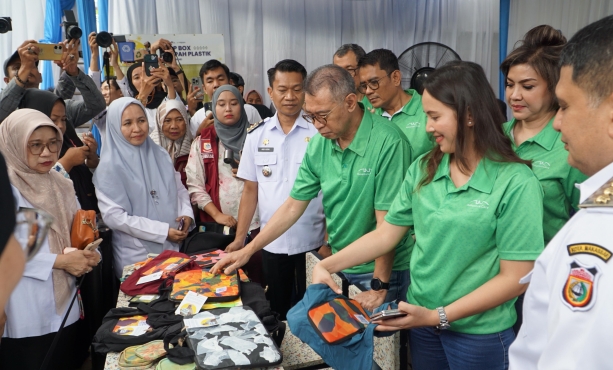
Since its launch in 2025, the program has been implemented in collaboration with Rappo Indonesia, a Makassar-based social enterprise. Beyond promoting the upcycling of plastic waste into environmentally friendly fashion products, the initiative also empowers women to take an active role in community-based economic activities, strengthening their position as key drivers of local economic growth.
Ramdani Basri, President Director of PT Nusantara Infrastructure Tbk, stated that the initiative reflects the Company’s commitment to delivering inclusive social impact across its operational areas.
“Women’s empowerment is a key pillar in building self-reliant and sustainable communities. Women are not only beneficiaries of this initiative, but also key enablers of the circular economy value chain it seeks to strengthen,” he said.
The program was launched in response to increasingly complex urban waste management challenges in Makassar. According to data from the Ministry of Environment/Environmental Protection Agency (KLH/BPLH), waste generation across the Greater Makassar area reached 1,644 tons per day in 2025.
Adopting a circular economy approach, the initiative engages local communities across the full value chain. Household waste is first sorted and channelled to the Kampung Bersih Nusantara Waste Bank in Pannampu Village, Tallo District. The collected plastic waste is then purchased by Rappo Indonesia, where it is cleaned and processed into recycled material sheets. These materials are subsequently crafted by women in coastal communities in Untia into value-added fashion products, including bags, wallets, and other accessories.
Over its first year of implementation, the program has processed more than 951 kg of plastic waste, converting it into 17,298 sheets of recycled material and 8,649 finished products distributed across Makassar, Jakarta, and Bali.
As part of its empowerment efforts, the program has provided women in the Untia community with training in product development and advanced sewing skills. This has not only enhanced their production capabilities but also created additional income opportunities and strengthened their economic independence. Beyond a standard CSR initiative, the program has evolved into an integrated, community-based ecosystem covering waste collection, production, and product distribution.
“While still at a pilot stage, the program demonstrates that effective waste management solutions can be driven from the community level. Moving forward, stronger collaboration between the government, private sector, and local communities will be essential in scaling the impact of a more sustainable circular economy,” Ramdani concluded.